Simulation has become an everyday tool
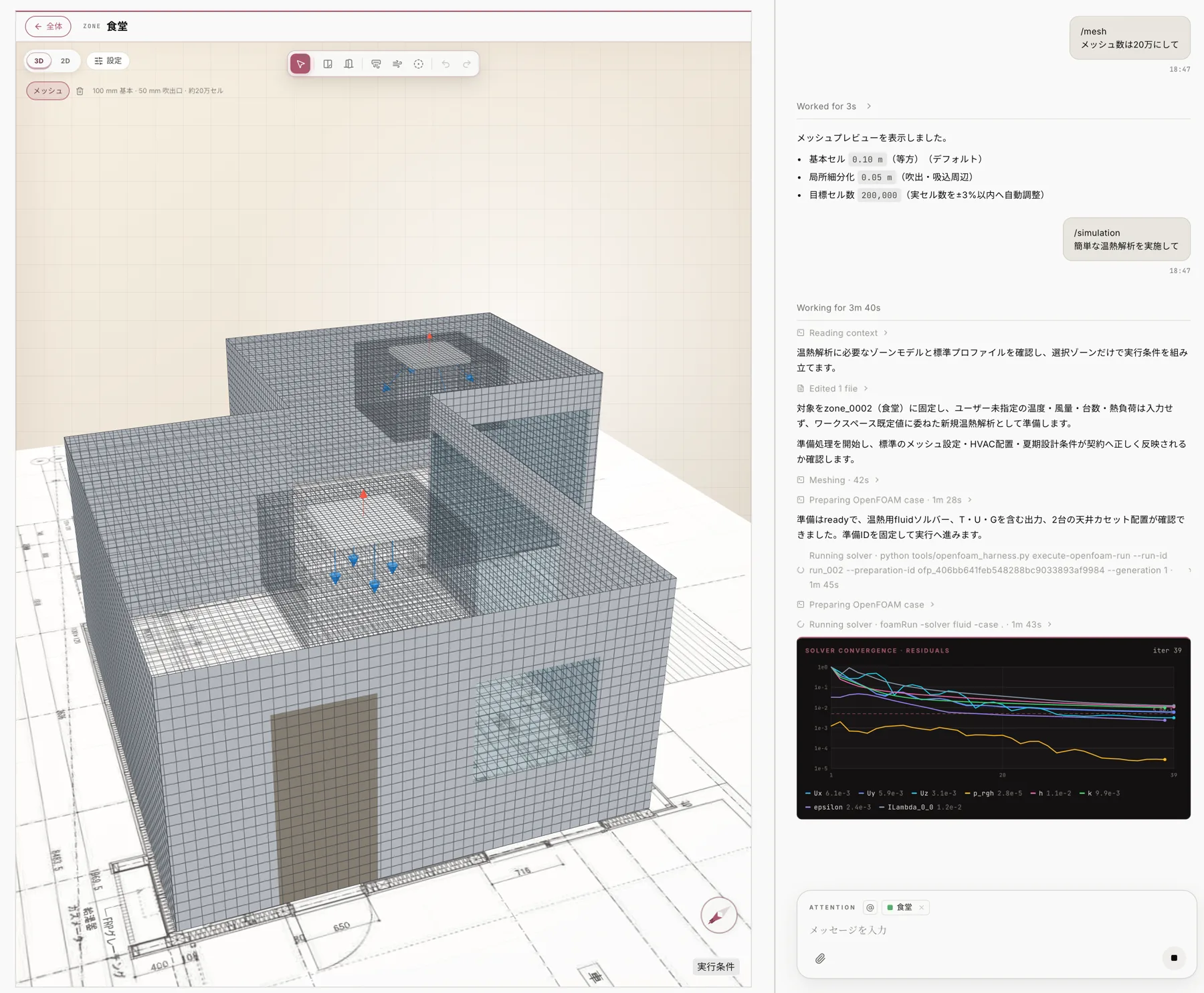
Montelo is a design-support tool that enables architectural designers without specialist engineering expertise to run thermal, airflow, energy, and other simulations intuitively.
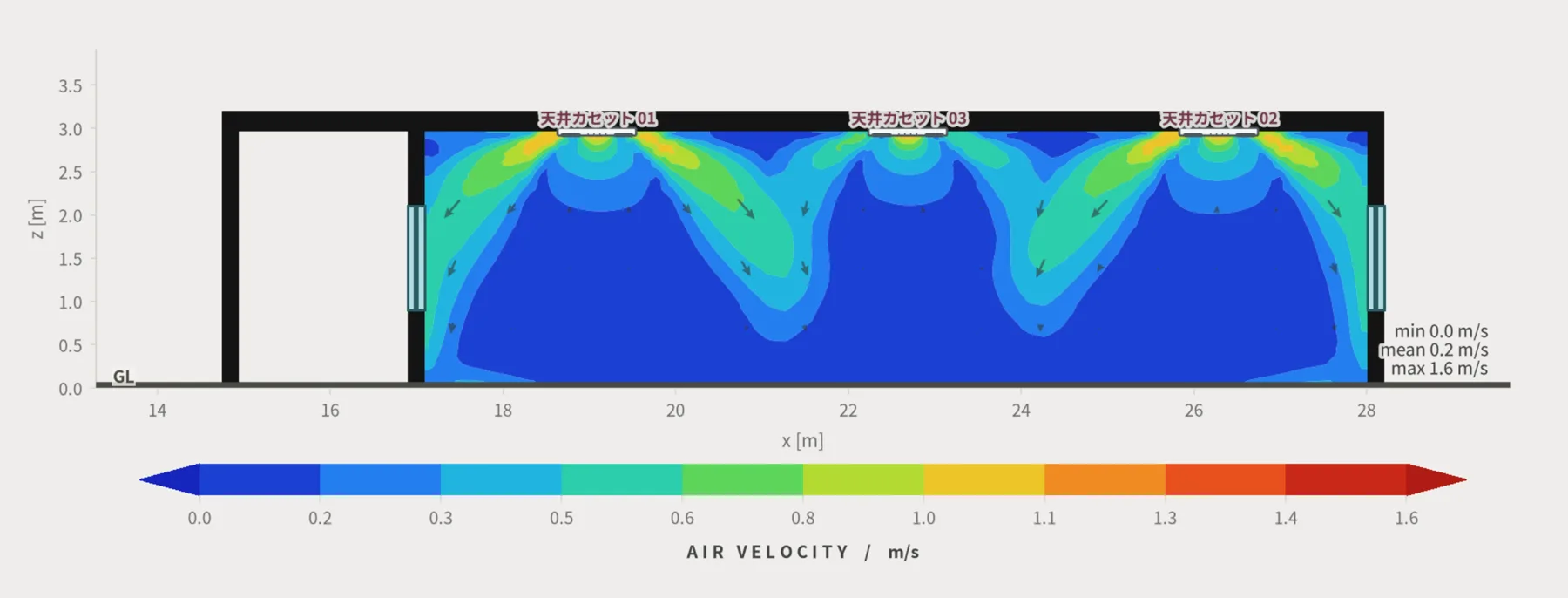
Until recently, analyzing the thermal environment or airflow of a space normally required several days of work by a specialist. Today, a designer can provide a drawing, explain that they want to understand the thermal environment of a room, and allow AI to run the simulation autonomously.
The AI interprets the drawing and creates or simplifies the model required for analysis. It then determines the conditions suited to the analytical purpose, generates an appropriate mesh, assembles the boundary conditions, and runs the solver. Its behavior when an error occurs is especially important: the AI identifies the cause from the error log, corrects the settings, and retries until the calculation converges.
Environmental simulation has become something non-specialists can use with ease in everyday architectural design work.
The invention is the interface, not the solver
How is this possible? To begin with, we did not invent a new method of simulation calculation or a new solver.
What we invented is not the solver itself but the interface for using it. A simulation interface stands between the user and the solver and gathers the model and configuration conditions needed for the solver to calculate correctly, without omissions or unnecessary inputs.
While developing Montelo, we formulated this process in a highly reproducible form and built a system to automate it. Each decision—where to place an air-conditioning unit, what airflow rate to set, or how finely to generate the mesh—is provided as an independent module.
The AI agent interprets the user's intent flexibly. It determines which values to set in each module and how to order and combine multiple modules, then carries out the required processing by solving how those modules should be connected.
We do not ask the AI to recreate the contents of every module from scratch. Allowing AI to write all the code freely would undermine reproducibility, increase the risk of hallucination, make cost and processing time unstable, and make errors harder to isolate.
By contrast, flexible combinations of modules can support requests closely aligned with a designer's needs—for example, running three analyses in parallel with only the set temperature changed, or reviewing the first result and refining the mesh only where airflows collide before calculating again.
The AI's actions are constrained within a prepared framework while retaining as much freedom as possible inside it. Designing this trade-off between stability and versatility is the most important part of keeping the interface reliable.
Which simulations will genuinely help the user?
At this point, some readers may wonder whether dedicated systems will become unnecessary once general-purpose models such as Claude and ChatGPT grow more capable.
That expectation is reasonable. As general-purpose models evolve, their spatial understanding and the accuracy of code generated from scratch will improve. Running a plausible simulation from a simple prompt may soon become commonplace.
The real question, however, is how simulation contributes to the user's design practice and expands human capability.
Designers are not seeking efficiency in simulation work for its own sake. They need insight that leads to better design decisions. That requires sophisticated interaction: the designer and AI must share the intent and assumptions of the simulation, and the designer must remain free to intervene throughout the process.
Returning control to people
This is the idea of Human-in-the-Loop, or HITL.
In software development, Cursor—which enables people to collaborate with AI through an editor—has attracted more users for serious development than Devin, which promotes fully automated code generation. Cursor CEO Michael Truell has said that the company also explored full automation but found that human requirements were too ambiguous for today's AI to make it work. Automating a process without understanding people's implicit intent is not enough.
Montelo likewise emphasizes a Human-in-the-Loop experience. Through chat, viewers, editors, and other functions, users can actively express their intent while work is in progress.
For example, the statement “I want to examine the thermal environment in summer” can imply very different analyses. Selecting air-conditioning capacity may call for heat-load calculations or energy simulation, while reducing direct solar radiation near a window makes the optical properties of the opening and mean radiant temperature more important.
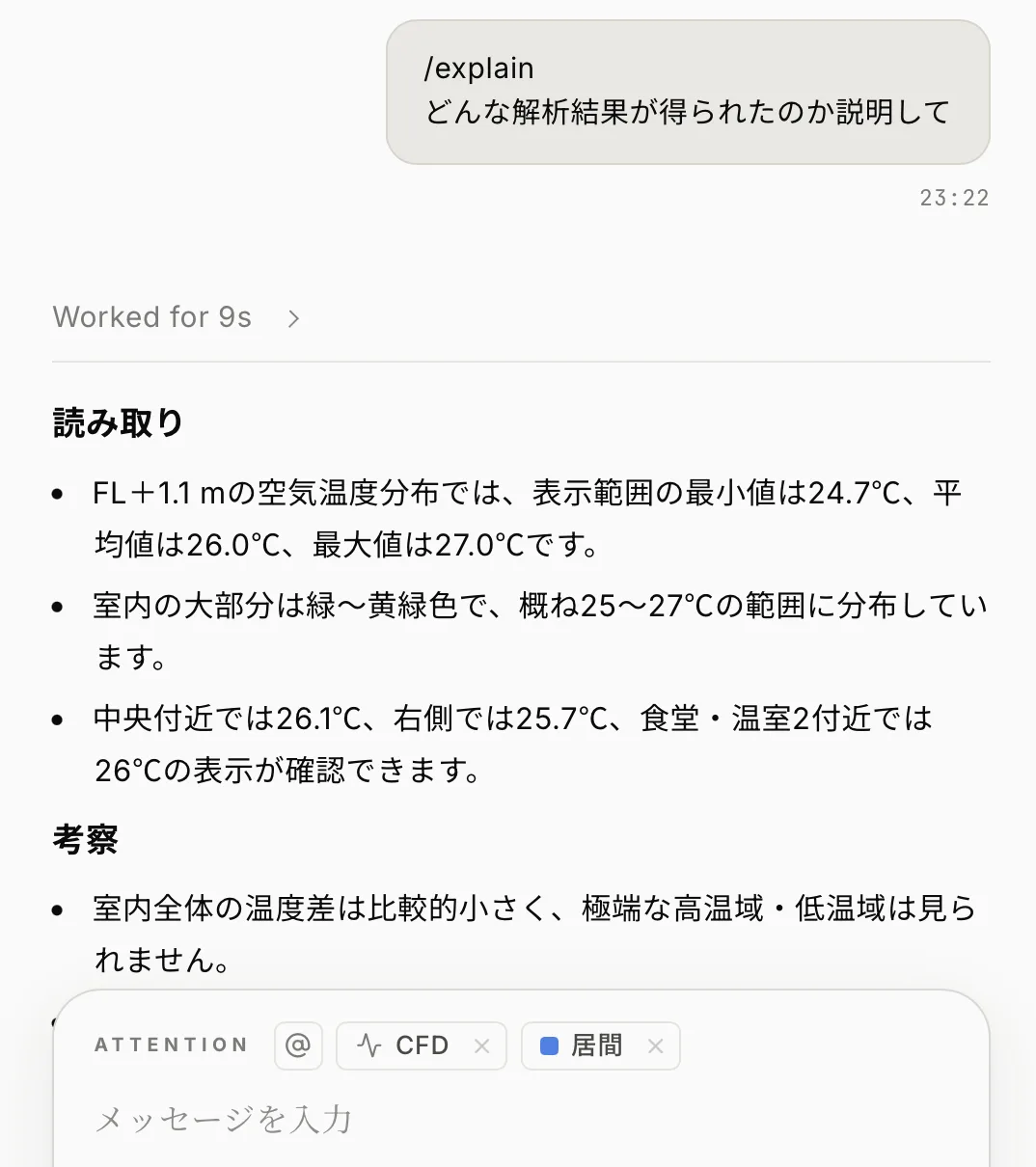
Through extensive customer engagement and a deep understanding of specialist knowledge and workflows, we are establishing a way to supplement the hidden context designers carry unconsciously and the intentions they have not yet put into words. When AI asks a question in return, designers may notice assumptions they had not been able to articulate themselves.
This capability should improve further as we gather valuable feedback from more users. No matter how capable general-purpose models become, they cannot replace this direct engagement with users.
What we want Montelo to provide is a feeling close to having an attentive specialist working alongside you: checking your assumptions, offering another perspective, and suggesting that you examine something else first when necessary. It does not take decisions away from the user; it proactively provides reliable material that helps the user decide.
So far, we have considered how AI can support human decisions through simulation. What happens if we take the system one step further and allow AI itself to create design options, compare and verify them through simulation, and improve them? In the next chapter, we will consider expanding simulation into a tool for exploring design itself.