Make ideas testable by anyone.
For everyone in architecture, construction, manufacturing, design, and academia who burns to create something new — we change the world in which imagination is left as imagination, and create an environment where ideas can be lifted into reality.
The problem we tackle
Imagination is disconnected from reality—ideas are blocked by the wall of verification.
Engineering's true role is to read the physical world accurately, predict its future, and support sound decisions with evidence.
Yet in domains governed by physical law — architecture above all — the engineering needed to predict how a new idea will perform in real space is still far from common practice.
Difficult theory, complex tooling, and the burden of configuration all consume enormous time and effort across every stage of verification. As a result, advanced verification remains locked behind a small group of specialists.
That is why many strong ideas never get casually verified, and are quietly abandoned long before they reach the real world.
Democratize physical intelligence, and make it the industry's everyday language.
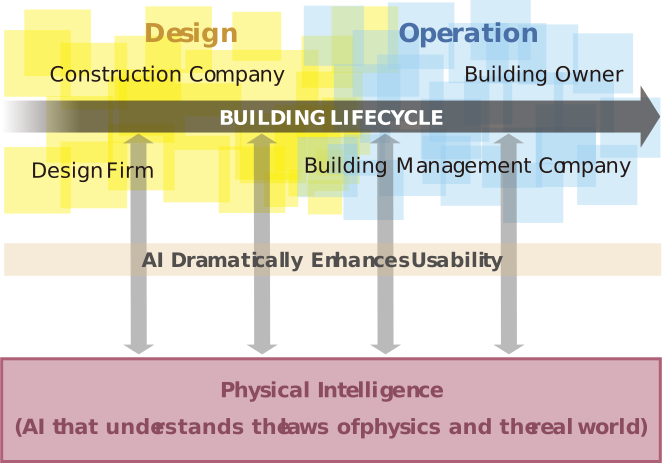
By fusing AI with the engineering used across architectural design and operation, we turn Physical AI — capable of understanding and correctly applying the physical world — into an everyday tool.
Engineering once locked behind a small group of specialists is opened to every designer and creator. The cumbersome work that lay between design and verification is cleared away, and analysis itself becomes far more efficient and far more capable.
From there, the moment an idea strikes you can run the cycle of "try, see the result, try the next one" at full speed. Humans concentrate on creative judgement, and outstanding ideas reach the real world one after another.
Montelo
A conversational simulation tool that seamlessly connects architectural design with analysis.
Montelo lets people involved in architectural design run advanced analyses — environmental, structural, and more — instantly, repeatedly, and on their own.
Through dialogue with an AI that understands the engineering of architecture, it prepares the data each analysis needs, runs the simulation, and stays alongside the user through visualization and discussion of the results.
Easy enough for non-specialists, while letting specialists dramatically streamline and elevate their everyday work — so every user can stay focused on the creative work of architecture.